
Fishing Line Pre-Collimation: Getting Close Before You Get Precise

Updated: 25 minutes ago

Every Newtonian telescope needs collimation. It is the job of lining up the mirrors so the light from the primary mirror lands exactly where it should in the eyepiece or on the camera. It is also the step that makes a lot of new telescope owners nervous, and I understand why. When you first look down the focuser of a brand new telescope, it can be hard to tell what you are even looking at, never mind which screw to turn.
So for the Skyward 200 I came up with a step that happens before collimation even starts. It uses a single piece of fishing line.
The Problem with Starting from Scratch
The secondary mirror is the small flat mirror near the front of the telescope. It sits at 45 degrees and turns the light from the primary mirror 90 degrees out the side of the tube to the focuser. If it is tilted the wrong way, the view through the focuser is a confusing jumble of reflections.
Normally you get it roughly in place by eye and then start fiddling. That works, but it is slow, and it is easy to chase your tail.
On a fast telescope like the Skyward 200 there is an extra wrinkle. The secondary mirror is deliberately mounted slightly off centre, which is called secondary offset. I love talking about this stuff, and if you are at one of our build sessions I will happily explain secondary offset to you for as long as you will let me. But most people building a Skyward are far away, learning from a manual or a video, and secondary offset is a hard thing to explain that way. I wanted something that would make sure their secondary mirror ends up positioned perfectly, whether or not the offset makes sense to them yet.
A Reference Built Into the Print
The spider housing on the Skyward 200, the printed part that holds the secondary mirror, has small holes and nubs built into it. You thread one continuous piece of fishing line back and forth through opposite holes and over the nubs, pull it tight and tape it in place. The lines stretch across right in front of the face of the secondary mirror.

Because the holes are part of the printed housing, the lines lie in the plane where the face of the secondary mirror is supposed to sit.
Line Up the Line
Now look at the secondary mirror. You will see each real fishing line and, just behind it, its reflection in the mirror.
If the mirror is tilted, the line and its reflection spread apart as you look along their length. Adjust the secondary tilt with the collimation screws and the line and its reflection come together. When there is only a vanishingly small gap between the real line and its reflection along their whole length, the mirror face is parallel to the lines, and the secondary is very close to where it needs to be.
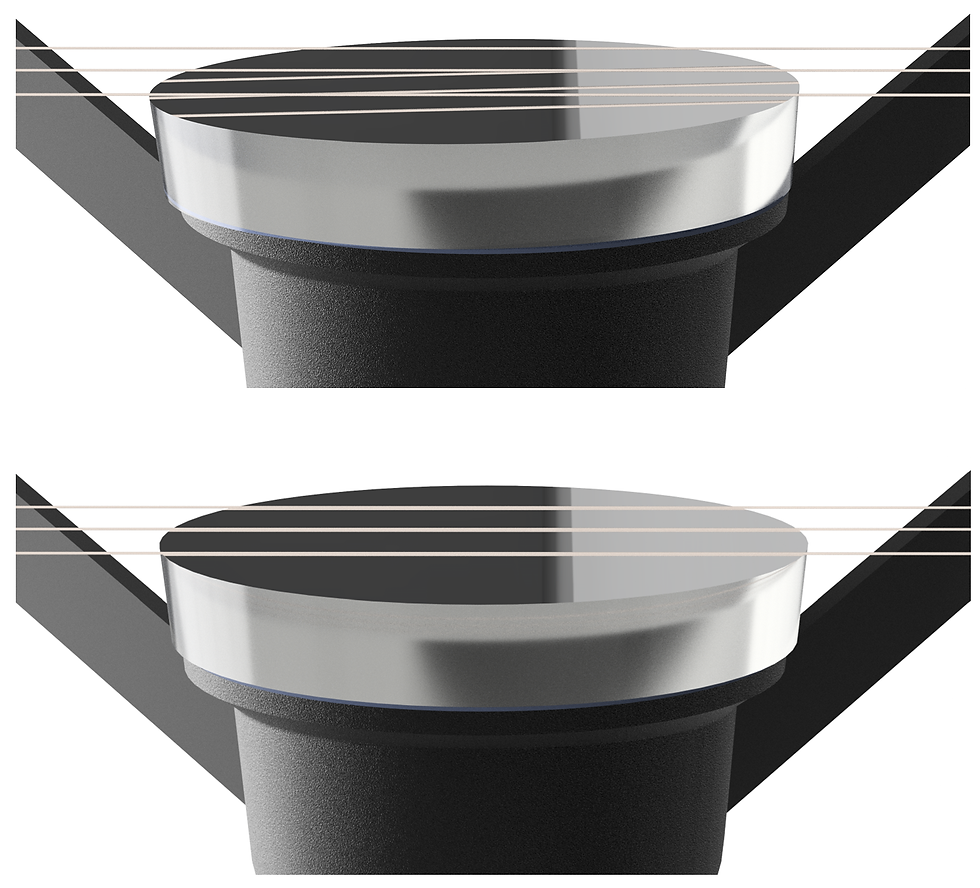
Don't force anything into alignment, and stop before the mirror touches the fishing line. If the line is being pushed out of place, you have gone too far. When you are done, take all of the fishing line and tape out before putting the upper baffle on.
A bit of fishing line and a piece of tape is all it takes.
Then the Real Collimation
This is a pre-collimation step, not a replacement for collimation. What it does is get you starting from close instead of starting from nowhere, so the real collimation becomes small adjustments instead of a hunt.
From there, start with a laser collimator. Do the secondary mirror first, then the primary. After that you can go directly to the tri-Bahtinov mask method I described in our post on Vasu's Heart Nebula image, which checks collimation on a real star.

Why Only the Fast Scopes?
The fishing line guides are on the Skyward 200, and the Skyward 400 does the same job with its own version of the idea. Both are fast telescopes, f/4 and about f/3.8, and the faster the telescope, the more critical it is to get the secondary mirror in the right place. The Skyward 150 is f/5, so it is more forgiving and doesn't have them.
The fishing line step is part of the new Skyward 200 build manual, which is about 150 pages and in final edits right now. Making that manual was a journey all on its own, and it will get a post of its own. Stay tuned!
Questions about collimating your Skyward? Ask on our Discord.
Join the Ten Telescopes Discord: discord.gg/kwv2z3wfGd


Comments